Snow mold symptoms and treatmentIn areas with persistent snow cover, evidence of gray snow mold (
Typhula incarnata) can be apparent as the snow melts:
- Gray snow mold symptoms can appear as a light brown, gray or bleached patches ranging from a few inches up to 2 ft. in diameter. Leaves will appear matted. Curative fungicide applications usually aren’t needed. Instead, rake or otherwise break up matted tissues and lightly fertilize in early spring to encourage new growth.
- Microdochium patch, on the other hand, can occur any time from late fall to early spring whenever conditions are overcast, cold and wet, and at snow melt. It can be treated with a curative fungicide application, such as Posterity® XT fungicide at 1.5-2.25 fl. oz.
Stay ahead of Microdochium patch development with the Microdochium patch
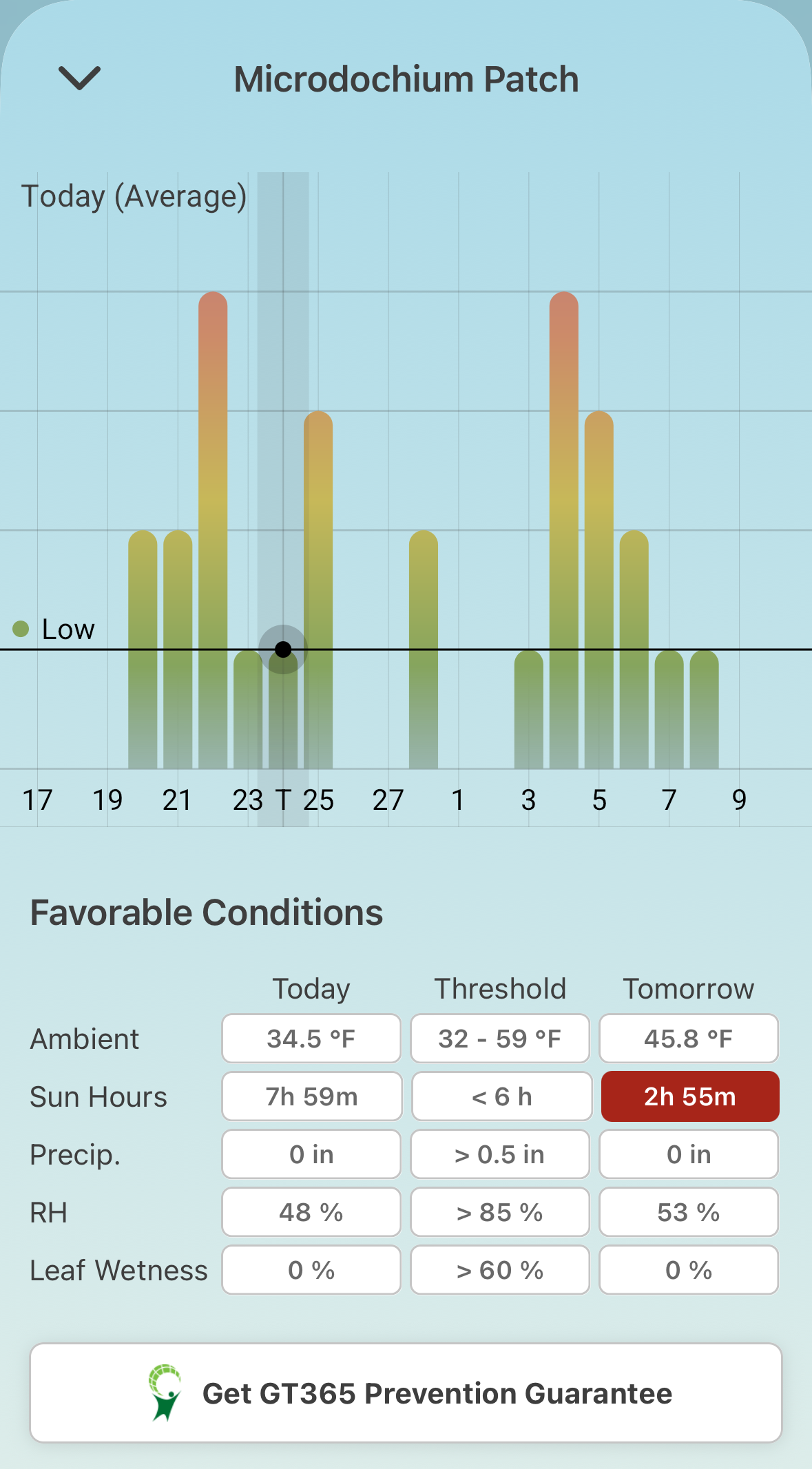
monitor in the
GreenCast® Connect app. GreenCast Connect uses advanced models and GPS-driven site-specific weather data to predict the risk of disease, weed and pest threats and sends timely alerts straight to your phone.

Source: Oregon State University, 2022. Applied on 28-day intervals on Jan. 12, Feb. 9, March 9 and April 6.
Additional spring diseases
Diseases such as yellow patch (
Rhizoctonia cerealis) and brown ring patch (
Waitea circinata) typically show up in the spring as temperatures begin to warm:
- Yellow patch occurs in the spring during periods of extended overcast, rainy weather and when temperatures are between 50-65°F. As a disease that impacts annual bluegrass and creeping bentgrass greens, collars and fairways, it's most severe when the thatch is cold and wet for long periods.
- Brown ring patch is a disease of annual bluegrass greens that is promoted by temperature ranges of 60-75°F, including overcast and rainy periods. Depending on the climate and spring warmup, preventive fungicide applications should generally occur between March 15 and June 1.
- Brown ring patch can resemble yellow patch in the field. To quickly diagnose brown ring patch versus yellow patch, check for mycelium by placing a sample of infected turf in a container or plastic bag overnight. If the sample has mycelium on the foliage, soil or thatch in the morning, brown ring patch is present.
- Anthracnose (Colletotrichum cereale) can occur in conditions that range from cold and wet to hot and dry. This is a stress-related disease, primarily on annual bluegrass greens and collars. Weather conditions and cultural practices that enhance plant stress will make the plant more susceptible to infection.
- Leaf spots are also commonly seen in the spring when cool, wet and overcast conditions persist.
- The timing of clean up applications coincides with the first fairy ring applications in many regions of the country.
Click the link of each disease above for more information including management tips, identification photos and how to mitigate disease pressure. For additional diseases, visit our full disease ID guide.
Posterity XT, Ascernity®, Briskway® and Daconil® Action™ fungicides are excellent choices in the spring for the diseases listed above. Each contains multiple active ingredients that provide broad-spectrum disease control.
Posterity XT is a reliable tool for early-season applications. It contains the active ingredient included in Posterity (pydiflumetofen), Heritage® brand products (azoxystrobin) and Banner Maxx® II (propiconazole) fungicides and formulated in a concentration optimized for extended control of more than 25 diseases. It provides turfgrass protection from important spring diseases, such as anthracnose, brown ring patch and Microdochium patch.
Ascernity is another excellent product for early-season applications. It contains the active ingredients in SOLATENOL® technology and difenoconazole (an SDHI and DMI combination). This fungicide is an excellent greens option for controlling brown ring patch and anthracnose. It contains one of only two SDHI fungicides that control anthracnose while partnering with a cooling DMI.
Briskway has an updated expanded rate range on its label. Featuring a combination of a DMI (difenoconazole) and QoI (azoxystrobin), this fungicide makes it an excellent option to start your season.
Ascernity + Medallion SC MultipakOffering 10% savings, the new Ascernity and
Medallion® SC fungicide Multipak combines Ascernity with the power of Medallion SC, a unique mode of action fungicide (FRAC group 12) for broad-spectrum control of several key diseases including snow mold, anthracnose, brown ring patch and yellow patch. Together, Ascernity and Medallion SC are excellent tank-mix or rotational partners for control of early spring diseases, and provide resistance management.
For more information about spring clean up, contact your local Syngenta territory manager.
All photos are either the property of Syngenta or are used with permission.
© 2026 Syngenta. Important: Always read and follow label instructions. Some products may not be registered for sale or use in all states or counties and/or may have state-specific use requirements. Please check with your local extension service to ensure registration and proper use. Syngenta supports a FIFRA Section 2(ee) recommendation for the control of gray or pink snow mold. Please see the Section 2(ee) recommendation to confirm that the recommendation is applicable in your state. The Section 2(ee) recommendation should be in the possession of the user at the time of application. Action™, Ascernity®, Banner Maxx®, Briskway®, Daconil®, GreenCast®, Heritage®, Medallion®, Posterity®, SOLATENOL® and the Syngenta logo are trademarks of a Syngenta Group Company. Spiio™ is a trademark of Spiio, Inc.